Video: The Go-to Tool for Modern Dental Marketing

This week, I am pleased to provide an article from a guest contributor.  Shane Walsh is a friend and colleague with more than 25 years experience in video production.  He is a storyteller at heart, and I’m excited to share with you his insights on video as a tool for modern dental marketing.

Video_tool_for_modern_marketerIn any given geographic area there will be dozens, if not hundreds, of dental practices vying for new patients. How are you communicating such that your practice brand comes out on top? When I hear the word “brand”, it’s synonymous with story. So, what is it that sets your practice story apart from the other practices in your area? And how are you telling that story?

The fastest, most effective way to communicate who you are and what your practice is about is video. Nothing retains potential patients on your site as effectively as video. When new (and current) patients are searching for information on a procedure or looking for a local dentist, and they come across a site filled with a static page of text, more likely than not, they will leave the site. The speed at which someone finds your site and then leaves is refereed to as the bounce rate.

According to a 2013 article from Entrepreneur.com, viewers are much more likely to remain on your site if it includes video. The longer a viewer stays on your site, the higher the chance they will take the next step and reach out via a contact form, email, or phone call.  (Of course, what happens when that email or call comes in is a topic unto itself.)

A well produced video allows potential patients to get a sense of who you are, by seeing you interact with staff & other patients and hearing your voice. Additionally, patients can get a sense of the office environment, from the artwork on the walls to the lobby area decor.

One key thing to keep in mind when producing a video for your practice is the story you wish to tell and the level of professionalism you need to attribute to your practice. Every aspect of your practice should invoke professionalism and align with your story, from the way you dress, to the demeanor of the staff, to the practice technology, to the business cards at the front desk.

I recently produced a piece for a dental office in Minneapolis, MN. They wanted to show how their practice was different and what to expect when coming there. The video came out fantastic and really captures the unique qualities of this practice. In a future article, I’ll take you through the process and how we went from concept to completion.

About the author:Shane Headshot 2012

Shane Walsh’s career in film and video began more than 25 years ago in the great city of Chicago.

During his travels, he has been lucky enough to work for some of the best film companies in the world, including Paramount Pictures and The Walt Disney Company. Shane has also had a chance to do work for some of the finest brands in the world including Panasonic, Toshiba and Verizon.

Shane creates everything from commercials to mini documentaries to features to instructional videos. The thing he loves most is telling stories. Shane loves getting to know a company and learning about what makes them special. Communicating unique and interesting stories is what drives us as humans.  From the earliest cave drawings to modern television shows, we learn best through story.

Posted in Dental, Getting Started, Guest Contributors, How to ..., Marketing | Tagged , , , , , | 3 Comments

Content Marketing for Dental Labs: Look Around You!

Nacera milled 2It can be easy for dental practice or laboratory owners, consumed with the day-to-day pressures of operating their business, to confuse content marketing (strategy) with social media posting (tactic).  “I have a Facebook page, so I’m doing content marketing, right?”  Of course, there’s more to it than that.  Content marketing is about providing insight and knowledge on relevant topics for your business’ customers and prospective customers.  It is about engaging in professional dialogue and helping your audiences to be more successful.  And it can be a critical strategy for dental labs to employ to set themselves apart from competitors who are still only using traditional marketing tactics.

In a recent whitepaper, LinkedIn detailed some results of a survey of over 1100 users centered on content, its professional value, and how, when, and where they consume it.  Among several key findings were the following nuggets:

  • For 70% of professionals, 20% of each hour spent online is devoted to consuming professional content…almost every day.
  • 52% of respondents agreed that “Professional content helps me to be a better decision-maker”
  • 67% said that they “like to be the first to receive and share professional content that others might find useful”
  • When asked to define “professional content”, 50% cited “news about trends in industry” and 41% noted “professional development, leadership, and productivity”

OK, that’s kind of interesting.  But what does it have to do with dental lab marketing?  I would argue quite a bit.  While dental labs have been on the forefront of adopting new materials and technologies to make dental prosthetics more esthetic, stronger, and quicker to manufacture (e.g., zirconium oxide and CAD/CAM), many have been slower to adapt their marketing tactics and adopt current content marketing strategies.  To this, I say simply “Look around you!”  As a dental lab, you are surrounded on a daily basis by content that your customers and prospective customers – dental professionals – would find relevant, could use to make clinical and practice decisions, and would consume to stay up to date on trends, productivity, etc.  Your lab, and the content you create and curate, can become a valuable resource on our industry and help dentists to be “in the know”.

So, maybe you’re smelling what I’m cooking here or at least considering that there could be some merit to it.  But, where to get started?  After all, doesn’t producing quality content require being an excellent writer with lots of spare time on your hands?  Not necessarily.  Again, look around you.  Consider that, in addition to blog articles, content can take many forms:

  • Slide shares of case reports detailing interesting or unusual clinical challenges and how your lab worked with the dentist client to solve them
  • Photo “essays” showing steps in a particular case
  • Tips and tricks for dealing with new technologies (e.g., “5 Tips for Sending a Perfect Digital Impression”)
  • Updates on new technology adopted by the lab and how it is helping to speed up turnarounds and/or improve clinical results – these could be written or video
  • Video tips (e.g. shade taking)
  • Q&A with customers or lab personnel – written or video

Basically, share your knowledge, passion, and insights.  Whether written, audio, photo, graphic, or video, the key is simply to get started with what you know and love.  Additionally, consider the following tips for connecting with your audience, namely the dentists you serve and those you want to serve:

  • Craft content that can assist in decision-making, either clinically or in practice management
  • Create (or curate) content which can spark discussion or sharing among peers
  • Produce content that can help to enhance knowledge or build their reputation through sharing
  • Always ensure you keep patients’ personal health information private and invisible

Pictures of kittens, “throwback Thursdays”, and “follow Fridays” are fun.  And, admittedly, these can help to show a lighter side.  But for the dental lab, content marketing doesn’t have to be a mystery or relegated to the “fun & games” category.  So many cases, so much data, so many client and patient stories come through the lab every day.  Use this to your advantage to build a content engine if you haven’t done so already.  The content is there…just look around you!

Thank you for reading.

Posted in Dental, Getting Started, How to ..., Marketing, Social Media | Tagged , , , , , , | 7 Comments

Lead Conversion – The Best and Worst Sources [Infographic]

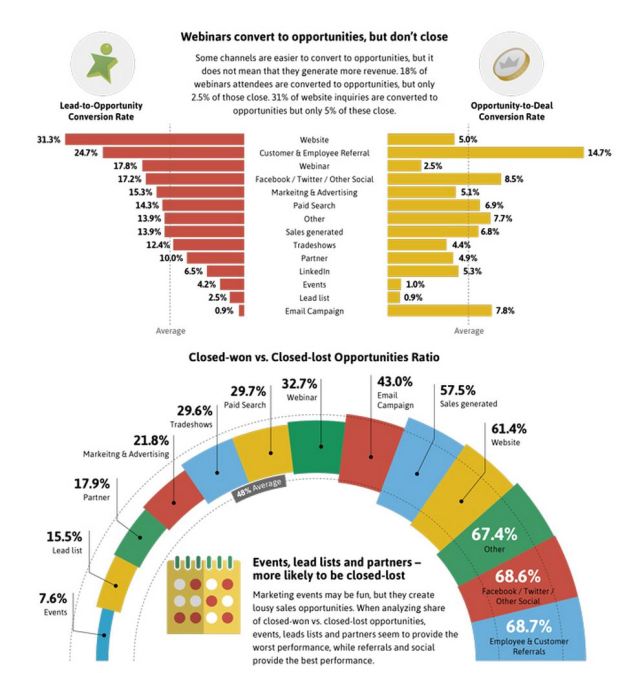
Recently Implisit, a CRM data and automation technology company, analyzed the sales pipeline data of hundreds of B2B companies.  Then, they used their findings to create a nifty and informative infographic.  The first part of that infographic is here:

Implisit Blog B2B Lead Conversion Infographic SnippetKey takeaways:

  • As you might have expected or experienced, B2B sales cycles, from lead gen to close, can be long.  While the specific companies and industries analyzed were not disclosed, this average sales cycle time rings true for dental capital equipment and technology purchases.
  • Customer referrals had the best conversion rate while lead lists had the worst.  This is expected.  After all, do you really expect to get sales from some list (of possibly dubious origin) you had to purchase?
  • Events were second to last, although webinars and tradeshows were given their own categories.  The types of events were not specified, only referred to as “company events”.  My takeaway from this is that these were more company branding “wine & cheese” receptions, rather than KOL speaker seminar events.  Events still have their place – corporate events can be great buzz generators for product launches and company branding.  If you’re looking for sales from an event, make sure it includes ample opportunity for customer referral elements.
  • Lastly the quadrant chart at the bottom helps to confirm the current evolution of B2B sales and marketing.  Social channels and PR are quickening the process of referral generation while (well constructed) websites are allowing prospects to do their own research faster.  Advertising, events, and tradeshows still have a place in branding and product launch, but they are less likely to yield lead conversion.

The second half of the infographic looked at opportunity to sale conversion:

Implisit Blog B2B Lead Conversion Infographic part 2 snippet


Key takeaways:

  • With the long sales cycle in B2B (and dental equipment and technology), don’t expect one tactic to take a prospect from lead to close.  A webinar may generate opportunities, but they may need to see some more info (customer testimonial videos perhaps) on a website custom landing page or get a hands-on demo in order to close.
  • Understand what your goals for each tactic (lead source) are.  And separate what tactics you expect to generate leads and sales directly vs. which tactics you employ for company and/or product branding.  If necessary, seek help.

I’ve written in several articles on this site that there is no “silver bullet” marketing tactic.  The data revealed in this infographic serve to underscore that point.  Employ the right tactics for the right goals (e.g., direct sales vs. brand establishment) and let your data help illuminate the way.

Thank you to Implisit for this analysis and to Hubspot for sharing it.  And thank you for reading.

Posted in Marketing | Tagged , , , , , , | 4 Comments